

OEM vs. ODM for Corporate Uniforms: Which Manufacturing Route is Right for You?

The procurement of corporate uniforms is fundamentally different from the ordering of ordinary promotional items. When dealing with the demands for high-end business suits, formal gowns, or durable work clothes for hundreds or even thousands of employees, the tolerance rate is extremely low. A poorly tailored suit or a piece of inferior fabric that wrinkles after washing can directly damage the brand image.
The core factors that determine the budget, delivery cycle, and project workload lie in the choice of production mode. Should we opt for the OEM (original equipment manufacturing) model or the ODM (design and manufacturing) model?
Although these terms are common in international trade, in the fields of suit customization and corporate uniforms, the actual operational differences between them are significant. In the following, we will deconstruct these concepts and examine how these two models are implemented at the factory level.
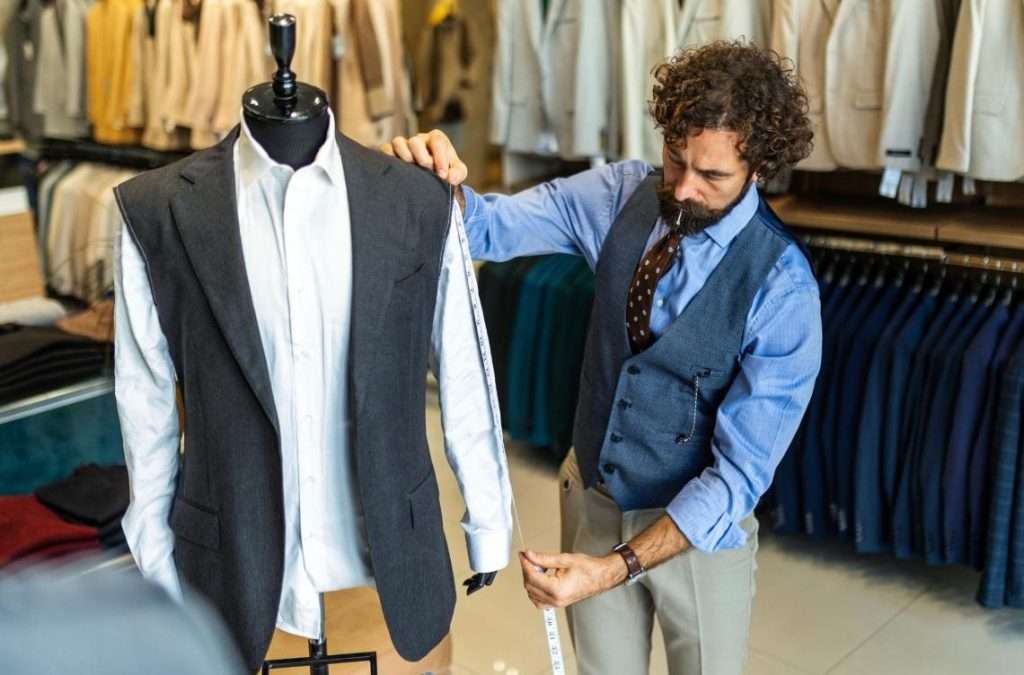
The OEM Route for Corporate Uniforms
OEM (Original Equipment Manufacturing) is essentially an authorized production model. In this collaboration, the brand owner is responsible for providing the design drawings, while the factory provides the labor force, manufacturing equipment and technical support.

If your company has an in-house clothing design team or external creative partners, OEM is usually the preferred model. You simply need to provide a complete design plan – that is, the technical package (Tech Pack) as commonly referred to in the clothing industry. This document typically includes:
- The pattern with precise stitching lines;
- A detailed bill of materials (BOM) covering the fabric, lining, padding hardness, and button materials;
- Standard size chart ranging from XS to XXL;
- Clear process instructions (such as specifying that the suit lapel lining should be made of semi-sheepskin or adhesive lining).
In the OEM model, the core function of the manufacturer lies in precise execution and perfect replication. The factory will rely on efficient CAD cutting machines, dedicated sewing lines and standardized quality control (QC) processes to transform your detailed drawings into high-quality mass-produced garments.
The ODM Route for Corporate Uniforms

ODM (Original Design Manufacturing) is an integrated service that covers the entire process from concept to completion. The factory is fully responsible for product design and manufacturing.
This model is highly suitable for purchasing managers, HR personnel or enterprise clients who require high-quality uniforms but lack in-house design capabilities or textile expertise. By collaborating with an ODM partner, you do not need to provide a technical package (Tech Pack). Instead, you only need to provide the following basic parameters:
- Brand visual identity: Vector logo file and enterprise standard colors.
- Wearing scenarios and requirements: For example, front desk staff need to maintain a proper appearance and they have to sit for long periods of time. Therefore, the fabric must have the properties of slight elasticity and anti-wrinkle.
- The budget target for each set of uniforms.
Subsequently, the internal design team of the factory will complete the subsequent processes: from fabric selection and pattern design to optimizing the armholes to ensure comfort during daily activities and providing you with finished sample garments. You only need to confirm the final sample, and then you can directly start the mass production.
OEM vs. ODM: Which Suits You Best?
To help you quickly weigh these two options side-by-side, we have broken down how they compare across the critical metrics of corporate procurement:
| Comparison Metric | OEM (Original Equipment Manufacturing) | ODM (Original Design Manufacturing) |
| Design Ownership | You retain 100% of the intellectual property of the design. | The factory owns the base design template, customized for your brand. |
| Material Sourcing | You specify and sometimes supply the exact fabrics. | The factory sources and recommends fabrics from their existing, tested supply chain. |
| Development Cost | Higher upfront costs (you must pay your own designers to create the tech pack). | Lower design costs (often bundled into the overall sample and production package). |
| Time-to-Market | Can be slower if your design requires multiple rounds of pattern adjustments. | Faster, as the factory uses pre-tested base patterns that are proven to fit well. |
| Minimum Order Quantity (MOQ) | Usually higher, especially if you require custom-dyed fabrics. | Often lower and more flexible, as factories can utilize stock service fabrics. |
Ask These 3 Questions Before Deciding
When choosing the options for the next batch of custom uniforms, it is advisable to first address the following three key questions:
- Have you prepared the complete technical package (Tech Pack)?
If so, you can directly choose the OEM (contract manufacturing) mode. It should be noted that merely providing a photo of a suit from the internet does not equate to a technical package. If there is a lack of precise size charts and manufacturing details, the factory will have to redevelop the pattern, which falls under the ODM (customized development) mode.
- Does your team have the capability to address the issues related to the pattern and the fabric?
Choosing the OEM model means that you are fully responsible for the fit of the clothing. If a slight adjustment to the size chart results in the cuffs being too narrow, the responsibility lies with the designer rather than the factory. If your team lacks experts in fabric and pattern making to handle these technical details, entrusting the fit and structural design to the pattern makers of the ODM factory would be a more prudent choice.
- Is your delivery period extremely tight?
Developing a complete suit design from scratch usually requires several weeks for pattern making and fitting adjustments. If your team urgently needs this batch of clothing to prepare for an upcoming corporate event or major activity, choosing ODM is undoubtedly a more efficient shortcut. ODM partners can directly utilize their mature and market-tested ready-made designs, quickly integrating your company’s VI color, thus saving you several weeks of development time.
LCBZ: ODM Corporate Uniform Manufacturer

Whether you have a clear brand concept, a complete Tech Pack, or ready-made samples, LCBZ is your reliable ODM clothing partner. We are dedicated to accurately converting your design concepts into high-quality, mass-producible corporate uniforms and ready-to-wear garments.
At LCBZ, quality is our fundamental principle. With our mature industrial production capacity and exquisite tailoring techniques, we ensure the success of every design for you:
- Precision cutting machine and digital coding: Utilizing a CAD digital coding system and an automated CNC cutting machine, it ensures that all sizes from XS to 5XL precisely meet the review standards, achieving zero deviation in cutting.
- Precise sewing techniques: The production line is specifically designed for formal wear and structured fabrics. Whether it’s the high-quality adhesive lining that shapes a crisp lapel, the traditional semi-sheepskin lining process, or the frequently used reinforced stitching for hotel uniforms, all strictly adhere to international sewing standards.
- Full-process multi-level quality inspection: From the shrinkage rate and color difference tests before the fabric is put into storage, to the on-site inspections during the sewing process, and to the final inspection of the finished products during the ironing process, through multiple stages of quality control, we ensure that the quality of the bulk production is exactly the same as the pre-production samples.
LCBZ strictly protects your intellectual property rights and adheres to delivery schedules. It provides high-quality products that meet your company’s supply chain procurement requirements.
